Canny Alternative — Lenit

Why startup teams pick Lenit over Canny

Same feedback board, roadmap, and changelog you'd get from Canny — with flat predictable pricing instead of per-tracked-user, AI features (dedup, autopilot, extraction) instead of dated point-and-click, and a UI that doesn't look like it shipped in 2017.

Canny is the established standard, but for startups and growing teams the per-tracked-user pricing makes the bill impossible to predict and scales up exactly when you don't want it to. The UI is dated, AI features cost extra, and the integration roster is built around enterprise sales stacks (Intercom, Salesforce, Gong) that startups without a sales team never use.

OVERVIEW

What is Canny?

Canny is a SaaS feedback platform founded in 2017 in Toronto, used by over 100,000 companies as their public feedback board, roadmap, and changelog tool. The recent Autopilot AI extracts feature requests from sales-stack conversations (Gong, Intercom, Salesforce). By most accounts, it's the de facto standard for product feedback management at the enterprise end of the market.

Three things make Canny a stretch for startups and growing teams. First, the pricing is per tracked user — anyone who comments or votes counts — so the bill is hard to predict and scales up exactly when you grow. Second, the UI hasn't seen a meaningful redesign since 2017 and feels dated next to modern SaaS tools, which matters when you embed the widget in your product. Third, the integration roster is built around enterprise sales tools (Salesforce, HubSpot, Gong, Intercom) — useful if you have a sales team driving feedback, dead weight if you don't.

CATEGORY

What startups actually need from a feedback tool

A customer feedback tool captures feature requests, bugs, and ideas from users in one place, lets the audience vote, and helps the team publish a public roadmap and changelog. Canny and Productboard define the high end of the market, but startups and small teams end up needing a different set of things than the enterprise checklist would suggest.

For a startup, the criteria that actually matter are these four:

  • Pricing that's flat and predictable — not "how much will I owe next month if usage grows"
  • AI features included rather than billed separately, since AI is most valuable when the team is small
  • Integrations with tools the team uses day-to-day — Slack, Google Workspace — instead of enterprise sales stacks
  • A webhook so when an out-of-the-box integration doesn't fit, the team can route data to their own server and build whatever they need
CANNY PRICING

Canny pricing — the per-tracked-user trap

What makes Canny expensive isn't the headline number ($79/month). It's the pricing model. Canny charges per tracked user — anyone who comments, votes, or submits feedback. The free tier caps at 25 tracked users, Pro starts at 100, and the bill scales up as you grow. Which means: at the exact moment you want costs to stay flat (early growth, PMF discovery), your feedback tool gets more expensive in lockstep with your success.

Layered on that: the Pro plan is billed yearly only — $948 upfront on day one. No monthly billing at that tier. The next jump (Business) is custom-quoted and clearly priced for enterprise. Lenit's Starter is just ~$7/month — you can launch a feedback board right away. AI features (autopilot capture, similarity dedup, feedback extraction) are available on the Business plan at ~$25/month, flat regardless of user count, with monthly billing available.

QUICK COMPARE

At a glance

5 biggest differences between Lenit and Canny

Lenit
Canny
Predictable pricing (no per-tracked-user)
AI features (dedup, autopilot, extraction)
Modern UI
Direct founder access
Webhook (custom server integration)
GAPS

Where Canny falls short

!

Per-tracked-user pricing — unpredictable bill

Canny charges per tracked user (anyone who comments or votes), so the bill scales up exactly when you don't want it to — early growth. Startup teams consistently flag this as the moment they stop and reconsider the tool: "how much will I owe in 6 months when this product takes off?"

!

Dated UI — 8 years without a meaningful redesign

Canny launched in 2017 and the UI has been incrementally tweaked but never fully redesigned. Next to modern SaaS tools it reads as "dated" — which matters more than it sounds when you embed the widget inside your own product and it brands your brand.

!

AI features cost extra

Canny's Autopilot AI and similar features are gated behind add-on fees or higher tiers. The teams that benefit most from AI — small ones — are the same ones who feel the add-on cost most. Lenit ships AI dedup, autopilot capture, and feedback extraction so smaller teams can use AI without an upgrade conversation.

!

Integrations built for enterprise sales stacks

Canny's integration list is heavy on enterprise sales tools (Salesforce, HubSpot, Gong, Intercom). If you have a sales team feeding feedback, great. If you're a startup without a sales motion, you're paying for integrations you'll never open.

!

Corporate support — not maker-to-user

Canny is a 50+ person team. Support runs through tickets and documentation. As a startup, you can't easily get a feature shipped on your timeline or have a quick chat about how the tool should work for your specific use case. Lenit is operated by the founder — direct access, fast turnaround on requests, roadmap influenced by users.

WHY LENIT

Why Lenit is different

Canny's core features — feedback board, roadmap, changelog, widget

Users post requests, vote on each other's, and the team publishes a public roadmap and changelog. The core feedback workflow you'd get from Canny is the same here. No "we'd switch but a feature is missing."

Flat, predictable pricing — no per-tracked-user

Lenit Starter is just ~$7/month — you get a feedback board right away. AI features (autopilot, dedup, extraction) are on the Business plan at ~$25/month. 100 users or 10,000 users — same price. Monthly billing available.

AI features — dedup, autopilot, extraction

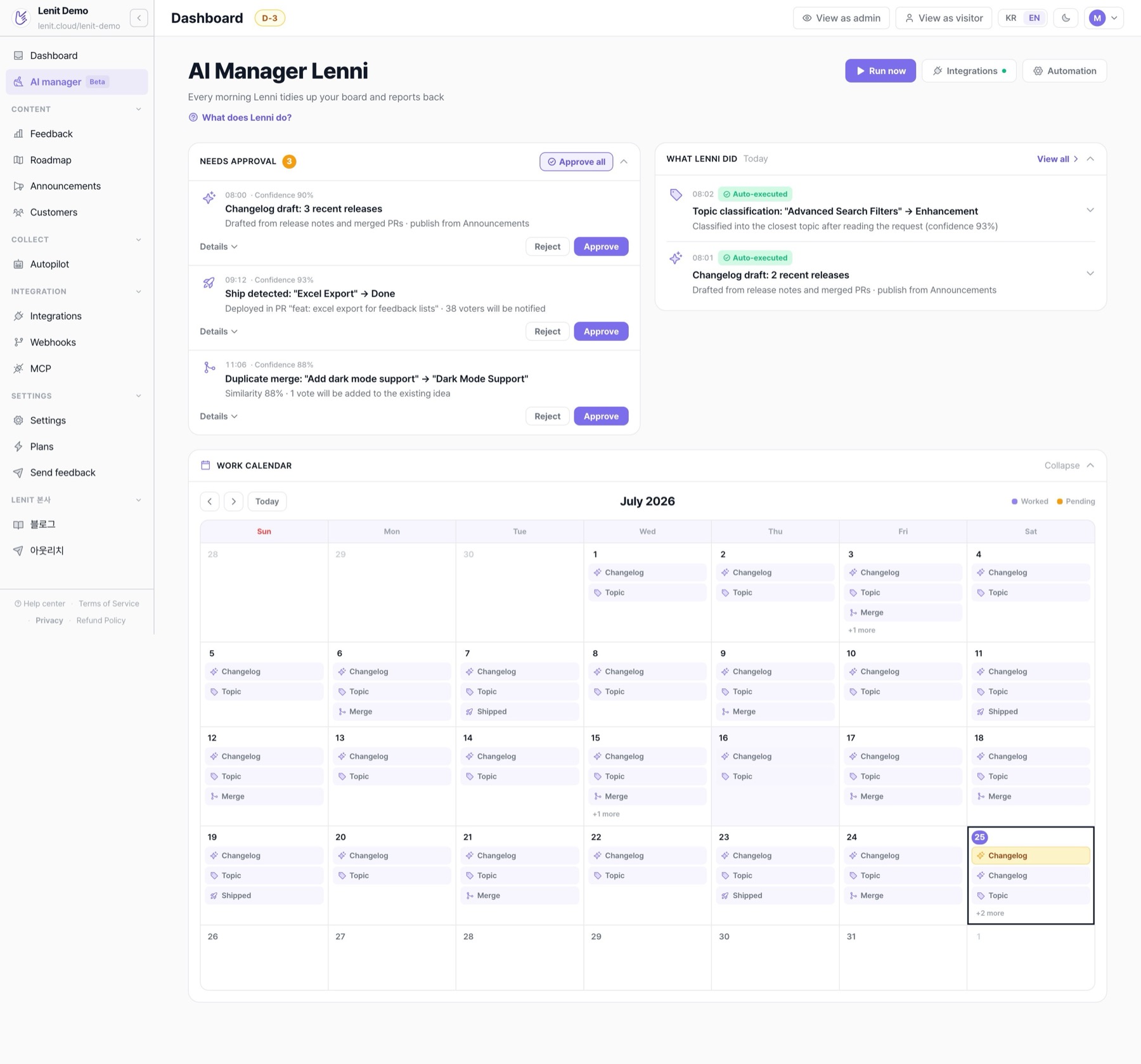
AI Autopilot (conversation → idea), AI similarity deduplication, AI feedback extraction, AI weekly reports. AI features are designed so even small teams get meaningful value — exactly when AI matters most.

Modern UI — designed for 2025, not 2017

Lenit's UI and embeddable widget are designed in the modern SaaS aesthetic. When you drop the widget into your product, it doesn't look out of place — it reads as "part of our brand," not "a third-party tool we glued in." Design is treated as part of the product, not an afterthought.

Direct founder access — maker, not support queue

Lenit is operated by its founder. Request a feature, report a bug, or ask "how should this work for our team?" — and you're talking to the person who can ship it. No ticket queues, no SLA latency, no auto-replies thanking you for your feedback.

Webhooks — bring data into your own server

When the out-of-the-box integrations don't cover what you need, the webhook lets your server receive every new feedback, vote, comment, and status change in real time. Route it to your own database, analytics pipeline, custom Slack notifications — whatever your team needs. "No integration available" isn't a blocker.

PRICING

Pricing

LenitLenit
Starter
₩9,900/mo (~$7)

50 ideas · 1 workspace · 1 admin · 5 topics · 1 webhook · roadmap, changelog, branding

BusinessPopular
₩35,000/mo (~$25)

+ All AI features (dedup, extraction, weekly report) · SSO + user identification (signed JWT) · 3 workspaces · unlimited ideas · 5 team members · unlimited topics · 10 segment analyses · 3 webhooks

Pro
₩69,000/mo (~$50)

+ Autopilot (Channel Talk, Slack, Email) · RAG (AI search/answer) · unlimited workspaces · 10 team members · unlimited segment analyses · 10 webhooks

CannyCanny
Free
$0

25 tracked users · core board

Starter
From $79/mo

100 tracked users — price climbs as users grow

Growth
From $359/mo (billed yearly)

1,000 tracked users · advanced features · priority support

Business
Contact sales (Enterprise)

SSO · security · SLA · custom integrations

CANNYLENIT

Migrate from Canny to Lenit in 5 minutes.

Bring boards, roadmap, votes, and comments over with a single CSV. Don't want to do it yourself? The Lenit team will handle the migration for you, free.

FAQ

Frequently asked

How is Lenit different from Canny?

Flat predictable pricing (no per-tracked-user), AI features (dedup, autopilot, feedback extraction), a modern UI, direct founder access, and webhooks for custom server integration. The core feedback board, roadmap, and changelog are the same.

Why is Canny's per-tracked-user pricing a problem?

Canny charges per tracked user — anyone who comments, votes, or submits. So the bill grows exactly when you don't want it to: early growth when you're trying to control costs. The free tier caps at 25, Pro starts at 100, and it tiers up from there. It makes "what will I owe next quarter" a guess instead of a budget line.

What AI features does Lenit offer?

AI autopilot (conversation → idea), AI similarity dedup, AI feedback extraction, and AI weekly reports. The set of AI capabilities available depends on plan — see the pricing page for the full breakdown.

Is migration from Canny free?

Yes. CSV import handles under 1,000 ideas in 5 minutes self-serve. For larger or complex migrations, we offer free hands-on assistance.

What can I do with the webhook?

We send your server a real-time event for every new idea, vote, comment, and status change. Store it in your own database, run it through your analytics pipeline, route it to Slack or your own dashboard — whatever fits your workflow. When a built-in integration doesn't exist, you build it.

ALTERNATIVES

Compare with other tools