
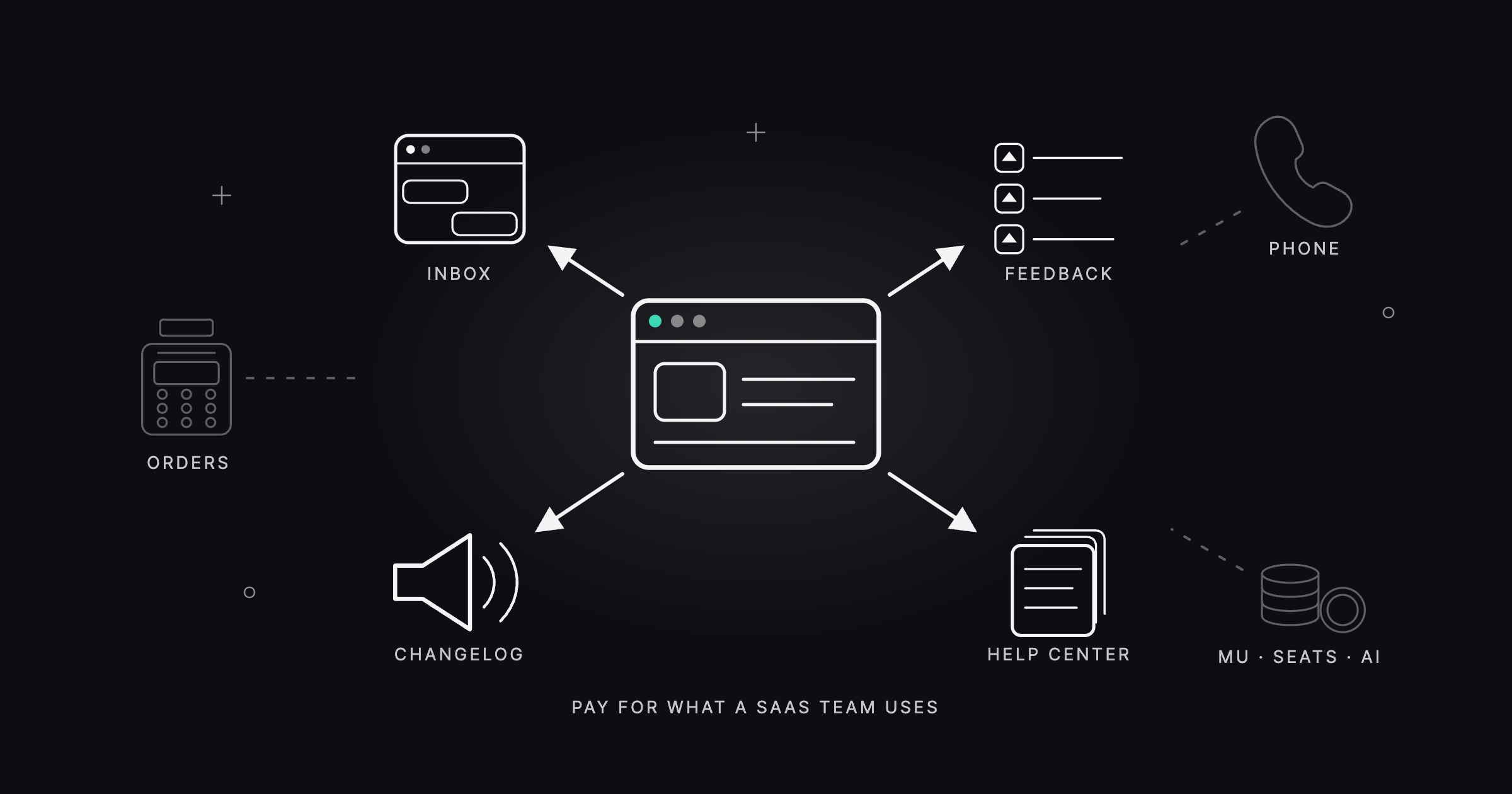
For a B2B SaaS team that mostly handles chat support, Lenit is the simpler fit; if you run an online store and need commerce integrations, phone and marketing in one tool, Channel Talk covers more ground. The real differences are feature scope and what the bill grows with.
Channel Talk is one of the most widely used support tools in Korea. Its listings on Cafe24 and NHN Commerce describe it as the "#1 e-commerce support solution," and the AI resolution rates published in its customer stories sit around 80%. If you run an online store in Korea, it covers a lot of ground in one product.
If you're building a B2B SaaS or web service, the comparison looks a little different. Channel Talk's feature set is centered on online stores, and its bill is calculated on three axes (customer count, seats and AI chat participations). If you want a predictable price and a path from inquiries to product improvements, Lenit, which bundles support, a feedback board, a changelog and a help center into one flat price, is one option worth comparing. This post lays out the numbers side by side.
What is Channel Talk?
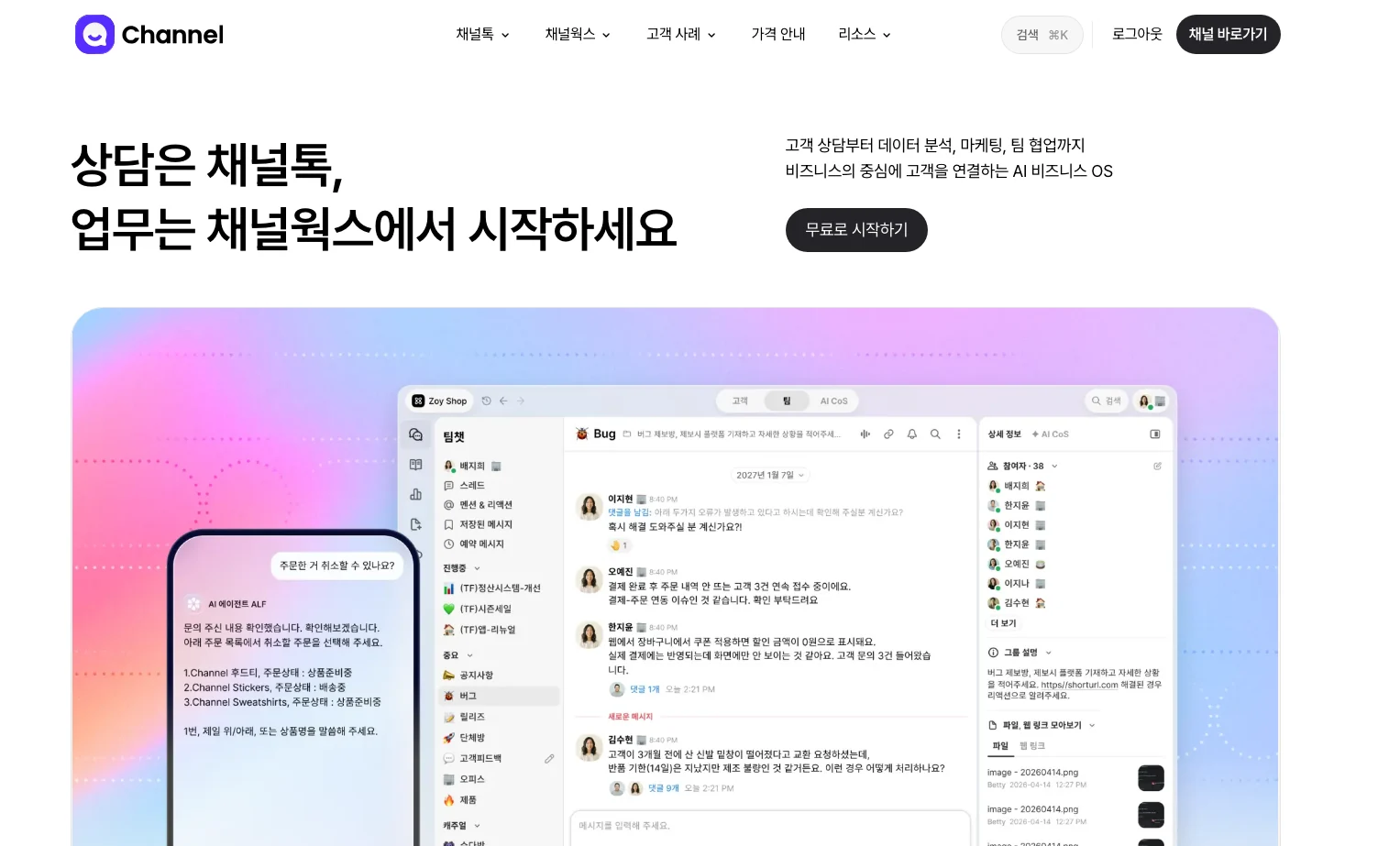
Channel Talk positions itself as an "AI business OS" that bundles support, CRM marketing, phone and an internal messenger. That's the wording on its official homepage as of September 2026. It covers every touchpoint a store needs: Cafe24, Shopify and NHN Commerce integrations, automated order cancellation and shipping lookups, marketing pop-ups and campaigns, and phone support.
Since October 16, 2026, new subscriptions start on Channel Talk's AI Edition: Free+ (₩0, with 2 support seats free), Startup at ₩200,000 a month and Business at ₩990,000 a month (12-month contract, prepaid annually; monthly installments cost 15% more; VAT excluded), plus custom Enterprise. Support seats, stored customers (MU) and chats handled by ALF, Channel Talk's AI agent, are deducted from a monthly CX credit (₩150,000 on Startup), and anything beyond it is billed on demand.
That's the structure described on the official pricing page and help docs as of October 17, 2026. Channel Talk's US pricing page lists the same plans at $0, $200 and $990 a month.
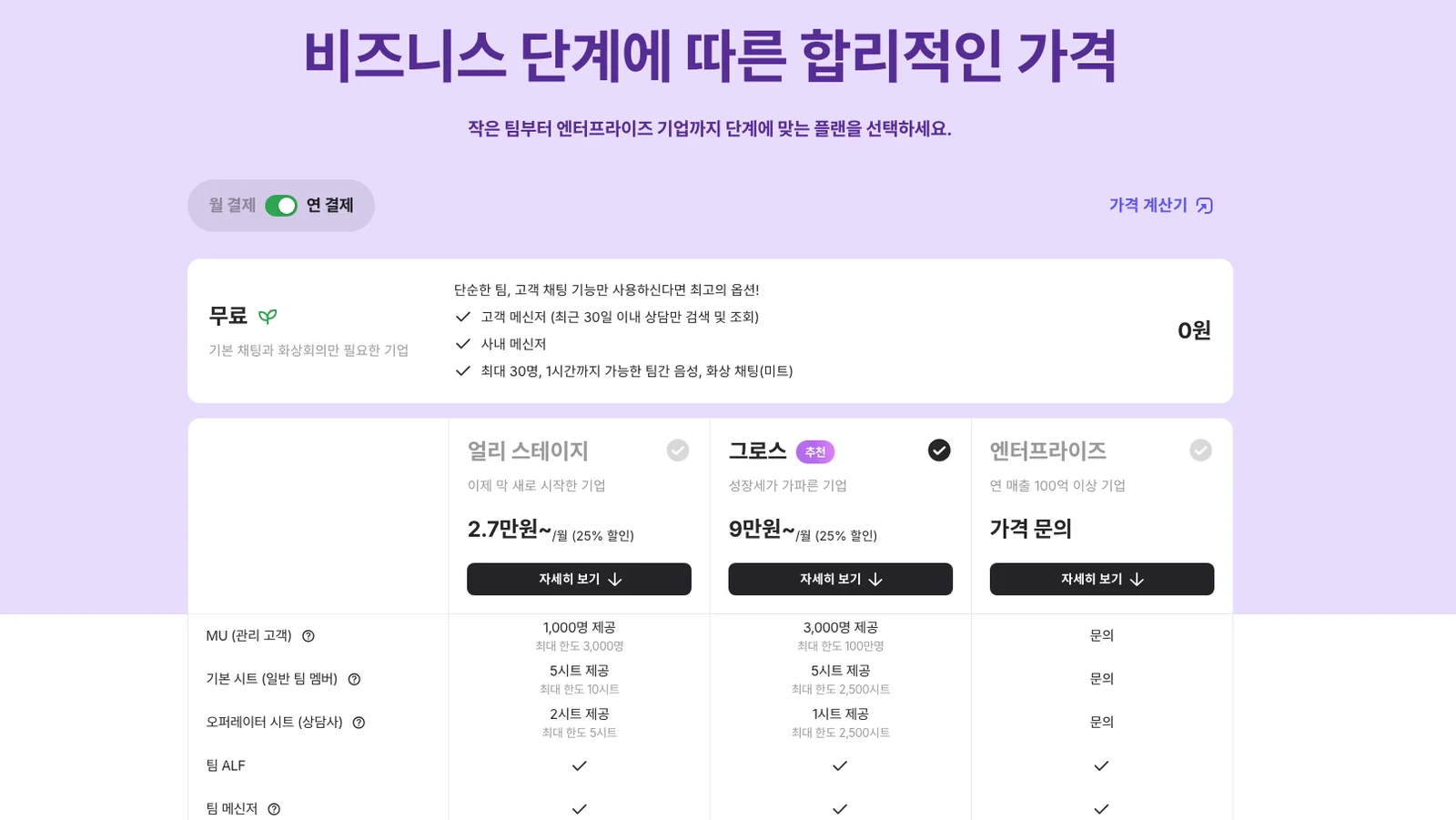
Channel Talk's pricing page before the October 16, 2026 overhaul (September 2026). New subscriptions now start on the AI Edition.
It wasn't always like this. Channel Talk started on flat pricing and switched to usage-based billing in 2023. At the time the team explained on LinkedIn that "as the number of customers grew and the spectrum widened, we hit the limits" of a single flat price. You can't charge a large enterprise and a one-person shop the same amount, so they moved to pay-as-you-use. It's a reasonable decision, but the result is a price you have to read not as "starting from" but as "what does it become once the team grows."
When do startups look for a Channel Talk alternative?
Teams usually start comparing around two questions: how much of the feature set they actually use, and how the monthly price changes with customer count and AI usage. A team that uses Channel Talk broadly gets a lot out of one tool; a SaaS team focused on live chat may find a different pricing model fits better.
The feature set is built around commerce
What a 10 to 30 person B2B SaaS actually uses in Channel Talk is live chat and AI replies. KakaoTalk, Naver TalkTalk and Cafe24 integrations, order lookups, SMS and KakaoTalk outbound messages, marketing campaigns and phone support are store features. Count the 19 customer stories on Channel Talk's homepage and most are cosmetics, fashion, food, airlines and cinemas. Maybe two could be called SaaS. Its core customer base is commerce, and its commerce features run deep.
Pricing is calculated on three axes
After the November 28, 2025 pricing notice, Growth listed at ₩120,000 a month (₩90,000 billed annually). It was sold until October 15, 2026 and now remains only for existing customers. On the AI Edition, stored customers (MU) cost ₩15 each per month from your credits (₩20 once credits run out) up to 10,000. If your sign-ups keep growing, it helps to estimate MU growth alongside the base fee.
You can also set an MU cap to put a ceiling on cost. But the official docs say that once you exceed the cap, "customers with the oldest last-seen date become unavailable to view and manage." It's worth deciding up front whether a cost ceiling or full access to older customer history matters more.
AI support is billed per chat participation
The biggest change in the November 2025 update was ALF's billing unit moving from "per resolution" to "per chat participation." The notice reads: "One unit is billed from the moment ALF starts its first reply until ALF ends its reply." A session the AI hands off to a human also counts as one unit, and the AI Edition bills the same way: ₩500 within plan credits and ₩700 once they run out ($0.50–0.70 on the US price list). Intercom bills Fin at $0.99 per outcome and Zendesk at $1.50 (committed) to $2.00 (pay-as-you-go) per automated resolution. The same AI support can be billed on quite different units depending on the tool.
If your inquiry volume is high, estimate the monthly number of AI sessions first. Plugging your own numbers into the calculator on Channel Talk's pricing page gives the most accurate picture.
Side-by-side comparison
Prices are from each vendor's official pricing page as of October 17, 2026. Channel Talk is listed in won on an annual contract (prepaid annually, VAT excluded); Lenit in US dollars, so the comparison shifts with the exchange rate.
Item | Channel Talk | Lenit |
|---|---|---|
Billing basis | Annual-contract plan + usage beyond monthly credits (support seats, MU, AI participations) | Flat per workspace (seats included) |
Starting paid price | Startup ₩200,000/mo (12-month contract, prepaid; ₩230,000/mo in monthly installments) | Starter $39/mo (3 seats included) |
AI support cost | ₩500 per AI-joined conversation within credits, ₩700 after; also on Free+ (₩700, up to 100 a month) | Included (300 replies per seat per month on Starter; routes to a human beyond that) |
As customers grow | MU usage comes out of credits, then billed on demand | No change |
Public feedback board, roadmap, changelog | None | Built into the widget |
E-commerce integrations, phone, marketing campaigns | Yes | No |
Let's run the same scenario through both: 3 agents, 5,000 stored customers, and 400 inquiries a month that the AI answers first.
Item | Channel Talk (Startup, prepaid annually) | Lenit (Starter) |
|---|---|---|
Base fee | ₩200,000 (includes a ₩150,000 CX credit) | $39 |
3 support seats | 3 × ₩30,000 = ₩90,000, deducted from the credit | 0 (3 seats included) |
5,000 customers | 4,000 MU (₩60,000) from the credit; the other 1,000 × ₩20 = ₩20,000 | 0 |
400 AI chats | 400 × ₩700 = ₩280,000 (credit already used up) | 0 (900 AI replies included; beyond that, chats go to your team) |
Total | About ₩500,000/mo, VAT excluded (≈ $357 at ₩1,400; about $500 on the US price list; calculated) | $39/mo |
The Channel Talk figures are calculated from the unit prices on its official pricing page and help docs as of October 17, 2026, VAT excluded. The order in which credits are used isn't documented, so the total can shift by about ₩4,000, and paying in monthly installments brings it to about ₩530,000. Every team's numbers differ, so get a real quote before you decide.
What makes Lenit different — one tool for everything customer communication needs
Lenit puts a support inbox, a feedback board, a public roadmap, a changelog and a help center into one product and one widget. You don't need Channel Talk or Intercom for support, Canny for a feedback board and GitBook for docs, each adopted, billed and embedded separately. Bundling everything a SaaS startup needs to talk to its customers is the point Lenit started from.
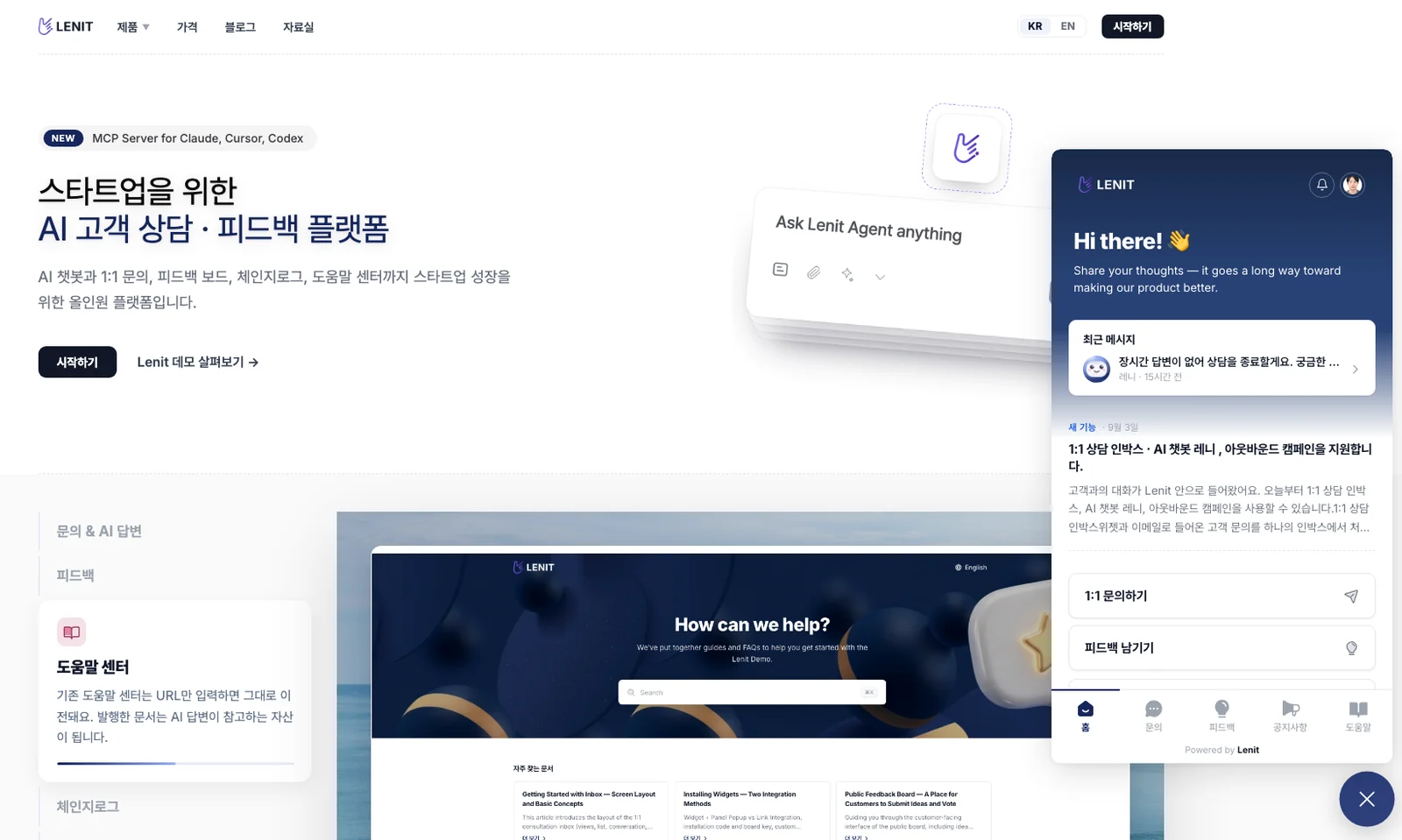
First, one tool, one invoice, one widget. For the team, support, feedback, announcements and docs live in a single admin. For the customer, a single button in the corner of your site lets them ask a question, request a feature, check the roadmap and search the docs. Run three tools and your customer data scatters three ways; in Lenit the same customer's conversation history and votes stay in one place.
Second, the price is flat. Starter is $39 a month with 3 seats and 300 AI replies per seat per month included. Whether you have 5,000 customers or 50,000, the price is the same, and there's no charge based on how many end users open the widget. There are also no three separate bills to add up and no three renewals to track.
Third, because it's all in one place, the pieces connect. AI support answers from the help articles in the same product, with no integration to set up, and when it has no source to cite it hands off to an agent instead of making something up. When "is there a feature for this?" comes up in a chat, the agent can point the customer to the feedback tab right next door, other customers vote, and the request shows up on the public roadmap. On the Pro plan, Leni, the AI agent, watches GitHub deploys, closes the related feedback, notifies everyone who voted and drafts the changelog entry (a human approves the final version). That's the loop product-led growth is about: OpenView defines PLG as a model where the product itself drives acquisition, conversion and expansion, and requests flowing from support back into the product are the core of it.
Gartner data from 2026, as cited on Intercom's Fin blog, puts the cost of a human-handled inquiry at about $13.50. If an AI grounded in your docs takes even half of those first, the math works. The actual savings depend on how each tool bills conversations the AI can't resolve, and whether the documents it answers from live inside the same tool.
Wrapping up
If you run a store, receive most inquiries via KakaoTalk or phone, or want marketing campaigns in the same product, Channel Talk fits that well. For a team building B2B SaaS or a web service, it's worth comparing three things side by side: how much of the feature set you use, how the price moves as customers grow, and how AI support is billed.
Lenit's answer to those three is a flat price, an all-in-one that bundles support, feedback, announcements and docs, and a loop that carries inquiries all the way to the roadmap. If you're weighing other feedback tools, our Featurebase alternative breakdown and top 5 UserJot alternatives cover the rest of the category. Lenit is free to start, and the widget is a single script tag. 🙂
Frequently asked questions
Can a SaaS startup run customer support on Channel Talk's free plan?
For a while, yes. Since October 16, 2026 the free plan is Free+: up to 2 support seats are free and you can view the last 30 days of conversations. AI chat is available on Free+ too, at ₩700 per conversation for up to 100 a month.
Does Channel Talk's ALF bill sessions the AI hands off to a human?
Yes. Since the November 28, 2025 pricing change, ALF is billed per chat participation at ₩500 (₩700 once plan credits run out). According to the notice, one billable unit runs from ALF's first reply to its last, so a session handed to a human still counts as one unit. Intercom Fin bills per outcome and Zendesk per automated resolution, so it's worth comparing the billing unit, not just the price.
Can Lenit replace Channel Talk, Canny and GitBook at once?
For the five basics, yes: a support inbox, a feedback board, a public roadmap, a changelog and a help center all live in one product. What Lenit doesn't have is Channel Talk's KakaoTalk channel, phone support, marketing campaigns and order integrations, or GitBook's advanced developer-docs features. It fits teams that want one tool for customer communication; if you need to go deep on one of those, a specialist tool is worth a look too.
When is Channel Talk still the better choice?
If you run an online store, or most of your inquiries come through KakaoTalk or phone. Cafe24 and Shopify integrations, order and shipping automation, marketing campaigns and phone support in one tool are what Channel Talk is built for. Lenit has no KakaoTalk or phone channel, so teams where those are the main channels are usually better served staying on Channel Talk.
What happens to existing support data when moving from Channel Talk to Lenit?
There's no one-click import of chat transcripts. Help articles can be re-published in Lenit's help center, where they immediately become the AI's source material, and accumulated feature requests can be imported by CSV into the feedback board. If you need old conversations, keep Channel Talk around for a month as a read-only archive, then cancel.
Does Lenit's price really stay flat as customers and conversations grow?
Yes, it's a flat workspace price. As of October 2026, Starter is $39/month with 3 seats and 300 AI replies per seat per month included, and there's no charge based on how many end users open the widget. The price only changes when you add agent seats or move to a higher plan. If you exhaust the AI allowance, conversations route to a human instead of triggering overage fees.