
An AI customer support chatbot costs your seat or plan fee plus AI usage, and for the same team the monthly total can differ by more than 10x between vendors. For a team of 3 agents handling 1,000 conversations a month, tools that include AI usage in the plan come to roughly $39–96 a month, while tools that bill per resolution or per session land around $350–630 (calculated).
What drives the gap isn't the unit price so much as what counts as "one" and whether the AI stops or keeps billing once you pass the included amount. This post uses official pricing from five vendors as of October 8, 2026, and walks through the math so you can plug in your own numbers. (Last updated: 2026-10-10)
What goes into the cost of an AI support chatbot?
Your monthly bill splits into three parts: the base fee, AI usage, and operating costs that never show up on the pricing page.
Base fee — agent seats or a workspace plan. AI support is often only available from a certain plan up.
AI usage — what you pay for the AI's work. The unit varies by vendor: resolutions, conversations, sessions, or credits.
Operating costs — time spent writing help docs and reviewing AI answers. It's not on the invoice, but it's real.
When you compare quotes, don't stop at the base fee. Plug in your own volume and look at the monthly total with AI usage added.
AI usage is billed in four ways
AI usage pricing falls into four models: per resolution, per conversation, sessions or credits, and included in the plan.
Per resolution — you pay only for conversations counted as resolved. Intercom Fin charges $0.99 per outcome; Zendesk charges $1.50 (committed) to $2.00 (pay-as-you-go) per automated resolution beyond what's included.
Per conversation — you pay for every conversation the AI replies in, resolved or not. Tidio Lyro starts at $32.50 a month for 50 AI conversations, and Channel Talk, a support platform popular in Korea and Japan, charges ₩500–700 (about $0.36–0.50) per conversation its AI joins.
Sessions or credits — usage is deducted by time-boxed session or by tokens. Freshdesk sells packs of 100 24-hour sessions for $49; Crisp includes $5–75 of AI credits in each plan, spent by tokens.
Included — AI usage is part of the plan price. Lenit includes 500–1,500 AI replies per seat per month.
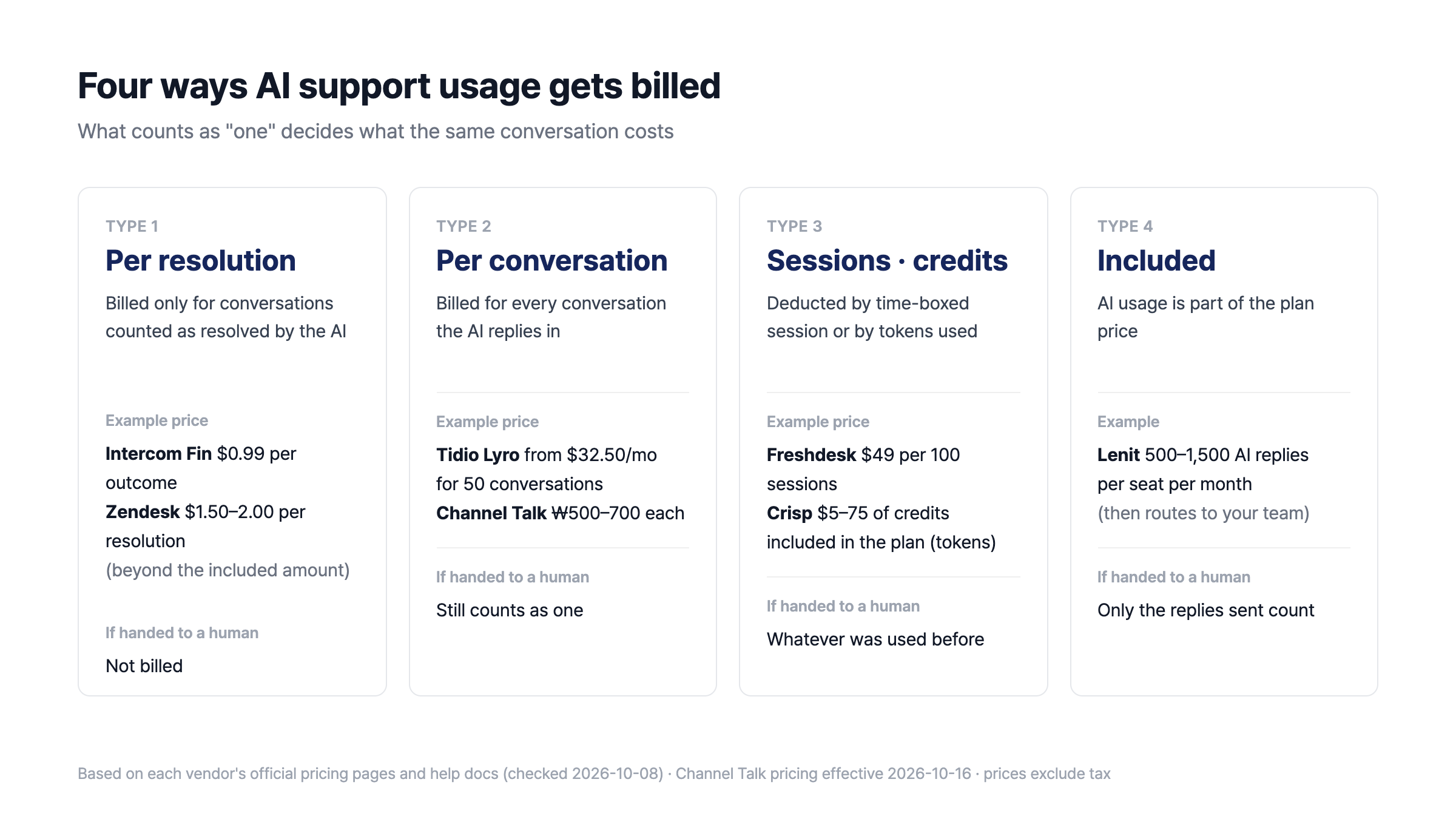
Four ways AI support usage is billed (official vendor sources, checked 2026-10-08)
Per-resolution pricing costs nothing for conversations the AI can't solve, but your bill rises as your resolution rate improves. Per-conversation pricing charges the same whether the AI solves the problem or not, so the real cost of one resolution is price per conversation ÷ resolution rate. At $0.50 per conversation and a 50% resolution rate, each resolution actually costs $1.00 (calculated).
"One unit" means something different at every vendor
Lining up unit prices side by side gives you a misleading comparison, because each vendor counts a unit differently and behaves differently when you run past the included amount.
Vendor | What counts as one | Handed to a human | Past the included amount |
|---|---|---|---|
Intercom Fin | An AI outcome (e.g. a resolution) | Mostly not billed (billed after a procedure handoff) | You can set usage limits |
Zendesk | An automated resolution with no human | Not billed | Default keeps answering and bills overage |
Freshdesk | A 24-hour session | Counted per session | AI stops and routes to an agent |
Crisp | Tokens used in the conversation | Whatever was used before handoff | AI stops and routes to an agent (keeps going if you enable pay-as-you-go) |
Tidio Lyro | A conversation with at least one AI reply | Counted once the AI has replied | Free plan stops; paid monthly plans auto-upgrade |
Lenit | Each AI reply sent | Only replies already sent count | AI stops and routes to your team ($0.04 per reply if you turn on overage) |
Intercom Fin is the best-known per-resolution model, so here's how it works in more detail, per Fin's help docs (checked 2026-10-08).
Price — $0.99 per outcome, charged at most once per conversation. Besides resolutions, a handoff to your team after Fin runs a procedure is also $0.99, and only lead qualification outcomes cost $9.99.
What counts as resolved — the customer confirms the answer helped, or doesn't ask for more help and doesn't come back within 24 hours of the last answer.
What isn't billed — conversations handed off because the customer asked for a person or frustration was detected, conversations where the customer left after Fin asked a clarifying question, and spam.
Base fee — with the Intercom helpdesk, you pay agent seats (Essential from $29 billed annually, $39 monthly) plus outcomes. On top of an existing helpdesk such as Zendesk or Salesforce, there are no seat fees: it starts at $49 a month with 50 resolutions included, then $0.99 per outcome.
Budget control — you can set usage alerts and hard limits, and Fin is unlimited during the 14-day trial.
Lenit counts AI replies rather than conversations, so a conversation with several back-and-forth questions uses several replies.
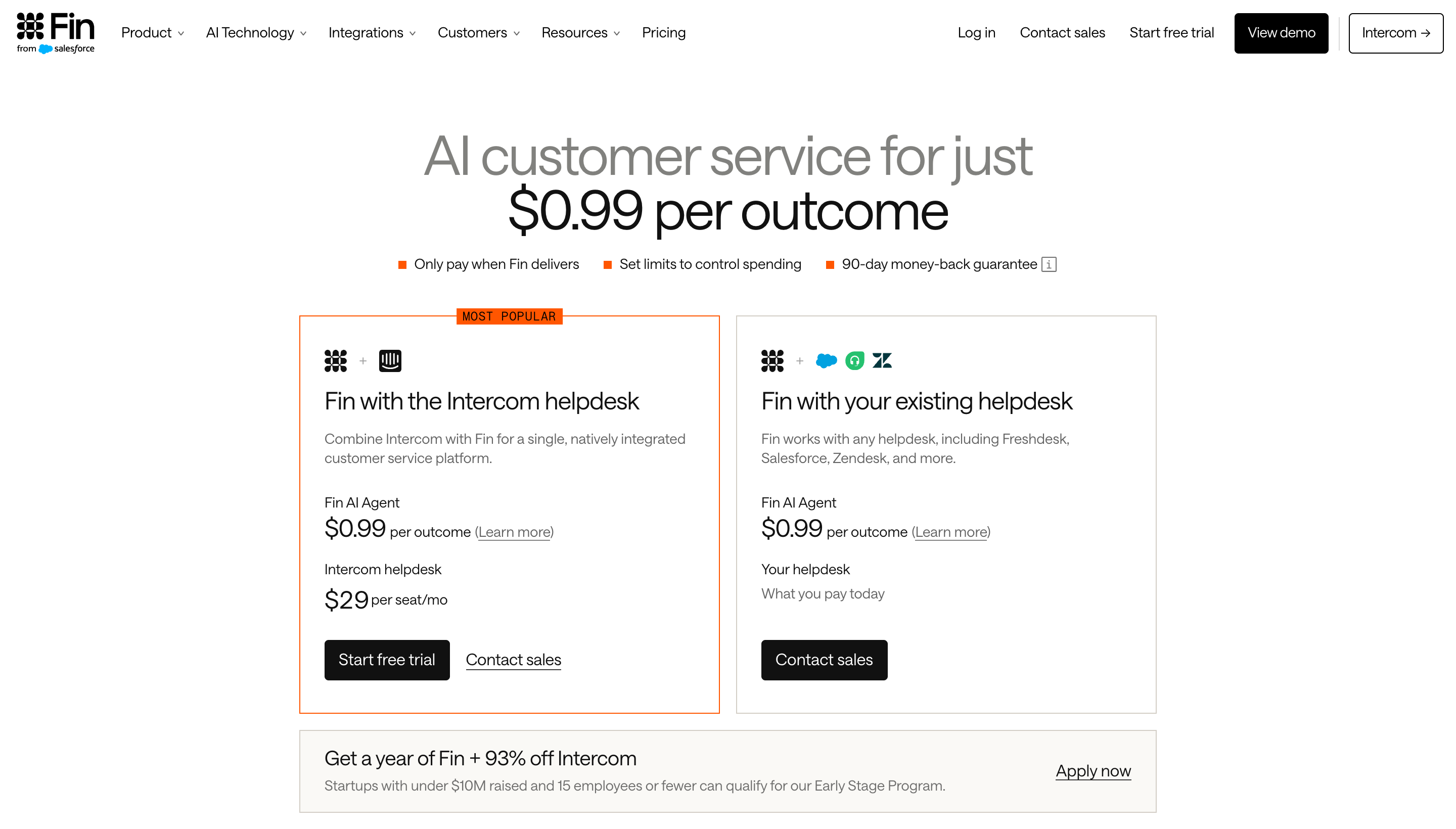
Source: Intercom Fin official pricing page (fin.ai/pricing), captured 2026-10-10
What does a team with 1,000 conversations a month pay?
A team of 3 agents with 1,000 conversations a month would pay anywhere from about $40 to over $600 a month once AI is added (calculated).
The assumptions come from the middle of the public figures in our AI chatbot resolution rate guide: 60% engagement and 50% resolution, so the AI takes 600 conversations and closes 300 without a human. The base fee is each vendor's lowest paid plan with AI, billed annually. For Lenit we assumed about 2.5 AI replies per conversation (per the Lenit pricing page). Tax is excluded.
Vendor | Base fee (3 agents) | AI usage | Monthly total (calculated) |
|---|---|---|---|
Lenit Starter | $39 (3 seats included) | ~1,500 AI replies, within the 1,500 included | $39 |
Crisp Mini | $45 (4 seats included) | $5 credit (~90 conversations) + 510 × $0.05–0.10 | $71–96 |
Freshdesk Growth | $57 ($19 × 3) | 600 sessions = 6 packs × $49 | $351 |
Intercom Essential | $87 ($29 × 3) | 300 resolutions × $0.99 | $384 |
Zendesk Support Team | $57 ($19 × 3) | (300 − 15 included) × $1.50–2.00 | $485–627 |
A few caveats. Crisp's per-conversation cost is the average estimate from Crisp's own help center. Freshdesk is calculated after the one-time 500 free sessions per account are used up. Zendesk's pricing page and help center describe different allowance systems, so your account may differ. Intercom bills in USD only.
The gap widens as volume grows. At 3,000 conversations a month under the same assumptions, every per-unit tool goes past $900 a month, while Lenit moves to the Pro plan with a larger allowance ($69) and Crisp comes to about $130–216 (calculated). At 300 conversations a month, the per-unit tools drop to $155–176 and the gap narrows. Per-unit pricing grows in proportion to volume; included pricing steps up only where you cross the allowance.
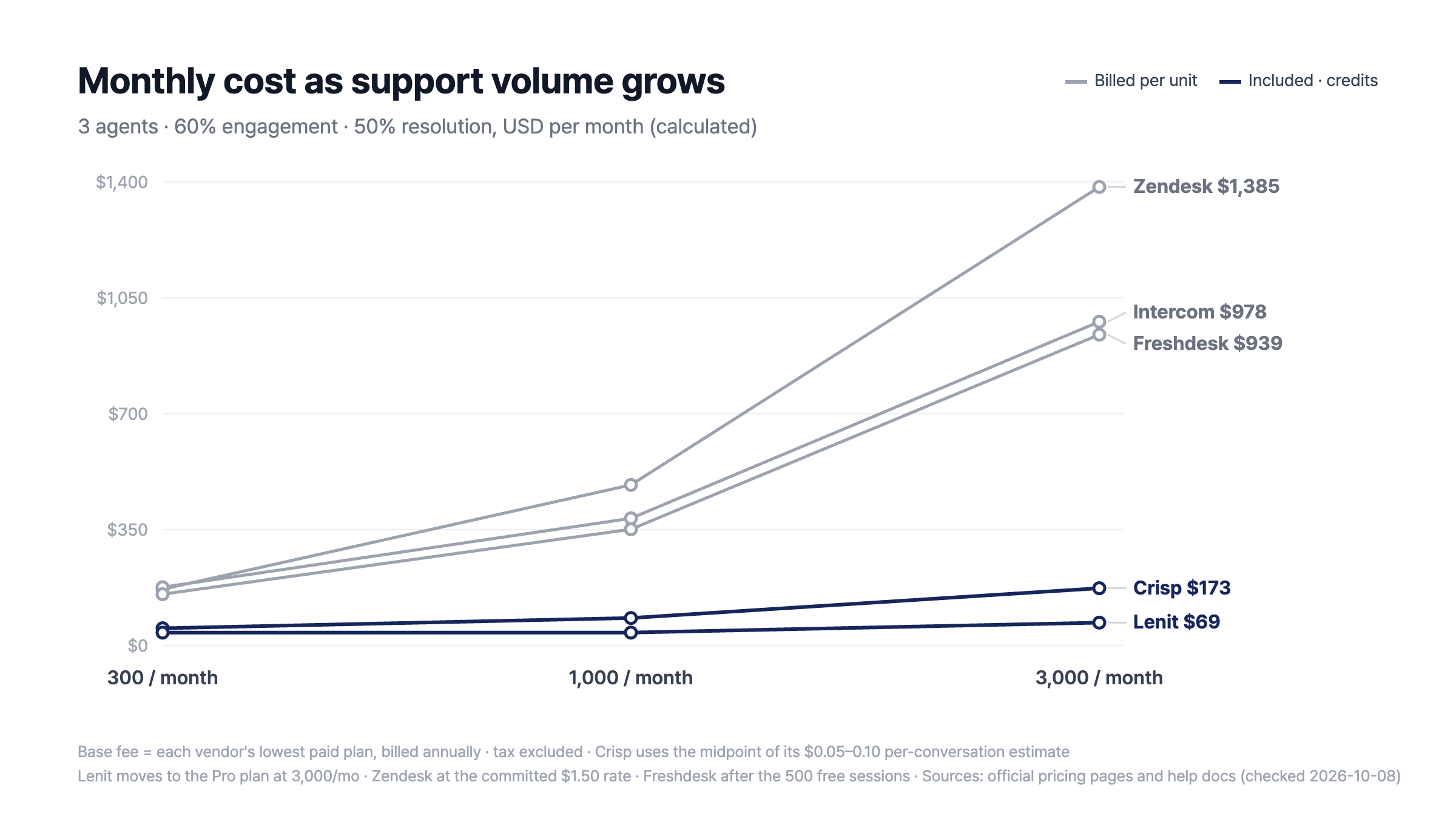
Estimated monthly cost by support volume (calculated from official pricing, tax excluded)
Costs that don't show up on the pricing page
Some costs only appear after you roll out. These are the ones we could confirm in official docs.
Testing uses your allowance — Freshworks deducts sessions even when you preview a bot while building it, and Crisp's test conversations spend credits too.
Allowances don't roll over — Fin's monthly included amount and Freshdesk's session packs expire at the end of the month or billing cycle if unused.
Some defaults keep billing — Zendesk defaults to allowing overage. Set a usage cap before you go live. Fin lets you set usage alerts and limits, and Freshdesk emails you at 70, 80, 90, and 100% of your sessions.
Help docs and answer review — in an Intercom report, 45% of support teams had added AI-related work to job descriptions, and 40% said agents now spend more time training the AI.
Don't count on AI prices falling forever, either. Gartner predicts that by 2030 the cost per resolution for generative AI in customer service will exceed $3 (published January 2026). So alongside today's unit price, look at how the bill moves when usage grows.
Is it cheaper to build your own?
On model fees alone, building your own is much cheaper. But a support chatbot needs a lot more than a model.
On OpenAI's pricing page, small models cost $0.05–0.40 per million input tokens and $0.40–2.00 per million output tokens (checked 2026-10-08). In exchange, you build and run everything else yourself: search over your help docs, a handoff flow when there's no answer, an inbox and conversation history for your team, and re-indexing whenever the docs change.
If conversations need to land in your team's inbox, compare a DIY build against support tools that already have AI built in. Engineering time to maintain it usually costs more than the tokens.
Picking the billing model that fits your team
Narrow the list by three things: monthly volume, expected resolution rate, and whether you need a hard budget cap.
You don't know your resolution rate yet → start with tools that bill only for resolutions (Intercom, Zendesk) or that include usage in the plan (Lenit, Crisp). Per-conversation pricing gets expensive per resolution when the rate is low.
Volume is high and growing → included pricing makes the monthly bill easier to predict.
You already run another help desk → Fin can sit on top of your existing help desk without paying for new seats.
You want the cheapest way to try AI → Tidio's free plan includes 50 lifetime AI conversations, and Intercom's 14-day trial includes Fin.
Lenit includes 500 AI replies per seat per month from Starter ($39, 3 seats), and when they run out, conversations route to your team with no extra charge. You can see this month's usage on the plan settings screen. Lenit is its own inbox, so it doesn't plug into another help desk the way Fin does.
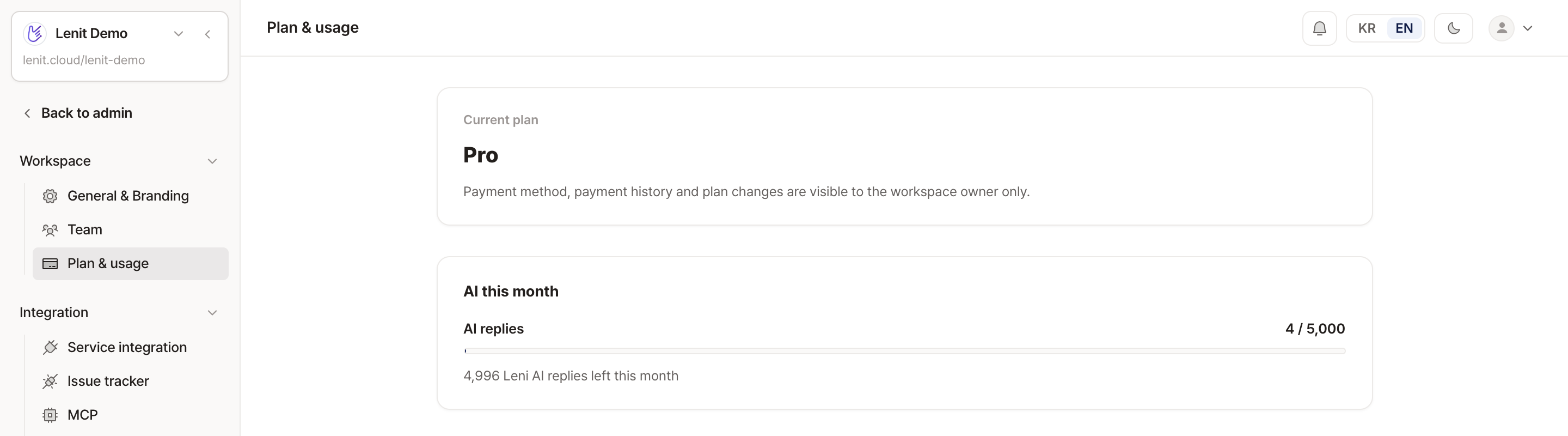
This month's AI reply usage on Lenit's plan and usage screen (demo data)
Wrapping up
You can't compare AI support chatbot costs on a single unit price. Put your monthly volume, expected resolution rate, and agent count into each vendor's pricing once, and check whether the AI stops or keeps billing past the allowance. Do that, and your first invoice won't surprise you.
How much AI actually cuts your support volume is in our AI chatbot resolution rate guide, and if you're comparing support tools, see the Crisp alternatives guide. Lenit is free to start, and you can try AI support during the 14-day trial. 🙂
Frequently asked questions
Can I start using an AI support chatbot for free?
Partly. Tidio's free plan includes 50 lifetime AI conversations, Freshdesk gives paid plans a one-time 500 free sessions, and Intercom's 14-day trial includes Fin. Crisp's free plan and Lenit's free plan don't include AI support, but you can try Lenit's AI during its 14-day trial (as of October 2026).
Which billing model is safest while my resolution rate is still low?
Per-resolution pricing or pricing with usage included in the plan. With per-conversation pricing, the real cost of one resolution is the unit price divided by your resolution rate, so at a 25% resolution rate a $0.50 conversation becomes $2.00 per resolution (calculated).
Do I have to sign an annual contract?
It depends on the vendor. Intercom, Zendesk and Freshdesk offer monthly billing, but their annual prices are lower. Crisp and Lenit let you start on monthly billing, and Lenit's annual plan works out to about one month free.
Are there startup discounts?
Intercom's Early Stage program advertises up to 93% off plus one year of Fin free. Eligibility differs by vendor, so check each official page.
What should I track during a trial to estimate the monthly cost?
Record three numbers: total conversations, conversations the AI took part in, and conversations that ended without a human. From these you get your engagement and resolution rates, which you can plug into each vendor's unit price to get close to your real monthly bill.